I. Why 4G Smart Fire Safety Is Revolutionizing Global Fire Protection
Fire safety is undergoing a fundamental transformation — from wired, locally-monitored systems to wireless, cloud-connected networks that provide real-time fire detection and alerting anywhere in the world. Traditional fire alarm systems — with their fire-rated cables, centralized control panels, and local-only alarm notification — have protected buildings for decades. But they have critical limitations: cables degrade over time (corrosion, vibration damage, accidental cuts during renovations), panels provide local alarm only (if no one is in the building, no one knows there is a fire), and installation in existing buildings requires disruptive and expensive cabling work.
The emergence of reliable, low-cost cellular IoT technology — 4G LTE, NB-IoT, and LoRaWAN — has created a new paradigm: fire safety devices that communicate wirelessly with cloud platforms, providing real-time monitoring, instant remote alerting, and automated compliance reporting. The global wireless fire detection market is projected to grow at 15-20% CAGR through 2030, driven by: mandatory smoke detector regulations in residential properties (20+ EU countries now require smoke detectors — millions of existing homes need retrofitting), smart city initiatives (governments deploying city-wide wireless fire detection in public housing, schools, and municipal buildings), aging building stock (wireless retrofit is the only practical solution for occupied buildings where cabling would disrupt operations), and the remote monitoring revolution (building owners and facility managers expect real-time alerts on their phones — not a panel buzzer they can only hear when on-site).
The WiFi Smoke Detector from Wanlin Fire Control is purpose-engineered for this market transformation — a professionally certified wireless fire safety device built on 4G/NB-IoT/LoRaWAN cellular IoT technology, manufactured by an ISO9001:2015 certified factory with complete EN54/EN14604/UL/FCC international certification. As a direct manufacturer — not a trading company — Wanlin provides factory-direct pricing that makes professional-grade fire safety affordable, and OEM flexibility that lets distributors build their own fire safety brand.
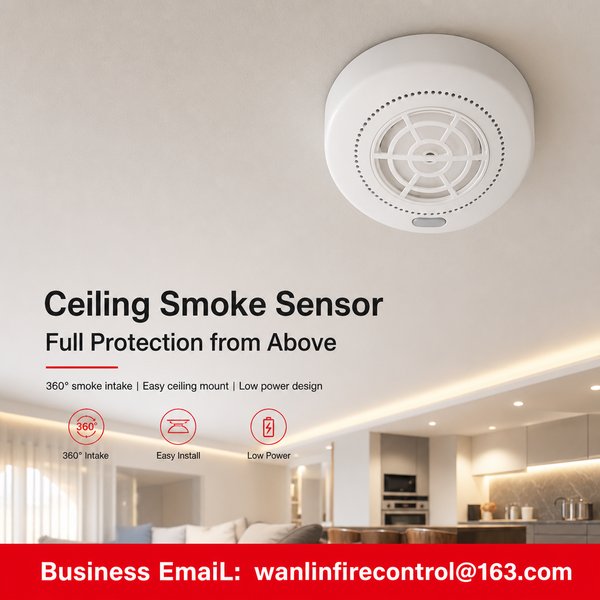
WiFi Smoke Detector — 4G Smart Fire Safety Product by Wanlin Fire Control
II. Product Specifications
Product Name: WiFi Smoke Detector
Brand: Wanlin Fire Control — 4G Smart Fire Safety Series
Product Category: 4G Smart Fire Detection & Alarm Device / IoT Fire Safety Equipment / Wireless Fire Safety System
Manufacturer: Wanlin Fire Control — ISO9001:2015 certified fire safety equipment factory, direct manufacturer and exporter
Communication Protocol: WiFi 802.11 b/g/n (2.4GHz) communication module. Supports WPA/WPA2/WPA3 encryption. TCP/IP, MQTT, HTTP/HTTPS protocols. Cloud platform integration via REST API. Direct-to-cloud communication without gateway (when WiFi is available).
Sensor Technology: High-sensitivity photoelectric smoke sensor with dual-wavelength infrared LED (880nm + 940nm) and photodiode receiver in a precision injection-molded labyrinth chamber. The dual-wavelength design provides discrimination between real smoke and nuisance sources (dust, insects, steam): the longer 940nm wavelength penetrates real smoke particles more effectively, while the 880nm wavelength is more affected by larger nuisance particles — by comparing the response ratio between the two wavelengths, the sensor reduces false alarms from dust and steam by 40-60% vs. single-wavelength photoelectric sensors. Sensitivity: 1.5-4.0%/ft obscuration (configurable). The labyrinth chamber features: a 360-degree smoke entry design (smoke from any direction enters the chamber), anti-insect screen (0.5mm mesh to prevent insect ingress — a leading cause of false alarms in traditional detectors), and conical chamber profile (reduces dust accumulation by promoting natural airflow). The sensor performs automatic drift compensation — as the chamber slowly accumulates dust over years of operation, the sensor baseline adjusts to maintain consistent sensitivity, preventing sensitivity drift and false alarms. In case the chamber becomes too contaminated for reliable compensation (typically after 8-10 years in normal environments), the device generates a 'clean sensor' or 'replace device' alert well before performance is compromised. Environmental compensation: the sensor adjusts detection thresholds based on ambient temperature and humidity to maintain consistent sensitivity across the full operating range (0-55 deg C, 5-95% RH). Self-test: the sensor performs an automatic internal calibration every 24 hours — verifying LED output, photodiode sensitivity, chamber cleanliness, and electronics — and reports any anomaly. Audible output: 85dB at 3 meters (meets EN14604). Visual indicators: green LED (normal operation, flashes every 60 seconds), red LED (alarm condition, flashes rapidly with siren), yellow LED (fault/maintenance required).
Alarm Output: Built-in piezoelectric siren: 85dB at 3 meters (per EN14604 smoke alarm standard, EN50291 CO alarm standard, EN50270 gas detector standard). This sound level is proven effective at waking sleeping occupants — including children, elderly, and individuals under the influence of alcohol (who have elevated arousal thresholds). Temporal-3 fire alarm pattern (per NFPA 72/ISO 8201): 3 short pulses, 1.5-second pause, repeat. This standardized pattern is internationally recognized as a fire alarm signal. For CO alarm: 4 short pulses (Temporal-4 pattern) to distinguish CO alarm from fire alarm per EN50291. The siren frequency (3.1kHz +/- 500Hz) is optimized for human hearing sensitivity and penetrates closed doors effectively. The device supports wireless interconnect — when one detector triggers, all other interconnected detectors in the system sound simultaneously, ensuring that a fire detected in the basement wakes occupants in the bedrooms on the second floor. Visual indicators: (1) Green LED — normal operation, flashes every 60 seconds. (2) Red LED — alarm condition, flashes rapidly synchronized with siren pulses. (3) Yellow LED — fault/maintenance condition. Optional integrated strobe light: high-intensity white xenon flash for hearing-impaired occupants. Optional voice alert: pre-recorded or customizable voice message (e.g., 'Fire! Fire! Evacuate immediately!' in the local language) — research shows voice alerts are more effective than tones at waking children and prompting evacuation. Optional relay output: dry contact (NO/NC) for integration with external systems such as elevator recall, HVAC shutdown, door release, or building management systems.
Installation: The WiFi Smoke Detector is designed for simple, tool-minimal installation by electricians, fire safety technicians, or facility maintenance staff. Standard ceiling/wall mount installation: (1) Secure the mounting base/bracket to the electrical box or directly to the ceiling/wall using the two included screws (ceiling mount for smoke/heat detectors, wall mount for gas/CO detectors at breathing height ~1.5m, ceiling or wall for sounder/strobe per NFPA 72 placement guidelines). (2) For addressable loop-powered detectors: connect the loop wiring (+ and - terminals) to the detector base. The detector base has two spring-loaded terminals — strip 8mm of wire, insert, release spring — no screwdriver required. The base is non-polarized (the detector auto-detects loop polarity). (3) For wireless battery-powered detectors: no wiring at all — simply secure the mounting base to the ceiling/wall with the two screws, insert the battery (if replaceable) or activate the device (pull the battery isolation tab on sealed-battery models). (4) Attach the detector to the base by aligning the index marks and rotating clockwise until it clicks into place. The detector auto-detects the base type (addressable loop base or conventional base) and configures itself accordingly. (5) For addressable systems: the detector auto-enrolls on the loop when the control panel performs auto-addressing — the panel discovers the detector, assigns a loop address, and prompts the installer for a location label. For conventional systems: the detector operates on the zone circuit — no addressing required. (6) For wireless systems: after physical installation, use the commissioning app to scan the device QR code and pair it with the gateway/cloud platform. The device auto-connects to the cellular network and registers on the cloud platform within 60 seconds of activation. (7) Test: activate the test function (magnetic test switch — wave the included test magnet near the marked test point — no ladder required for ceiling-mounted devices, or press the physical test button, or use the app's remote test function for wireless devices). The device performs a full self-test: sensor check, siren activation, wireless transmission test, and battery health check. The test result is reported to the control panel (addressable) or cloud platform (wireless).
Cloud Platform & Data Management: The WiFi Smoke Detector leverages Wanlin's cloud-based IoT platform for comprehensive fire safety data collection, analysis, and management: (1) Device connectivity — each device maintains a persistent or periodic connection to the cloud platform via its cellular (4G/NB-IoT) or IP (WiFi/Ethernet) communication module. The connection uses MQTT protocol (lightweight, efficient, designed for IoT) with TLS 1.3 encryption for data in transit. The device transmits: periodic heartbeat (every 60 minutes by default, configurable) with device status, battery level, signal strength, and sensor self-test results. Event-driven transmissions (immediate): alarm activation (smoke/gas/CO/heat detected), alarm restoration (condition cleared), fault detection (sensor failure, low battery, tamper, communication error), and device configuration changes. (2) Data analytics — the platform applies big data analytics to the collected device data: predictive maintenance (identifies devices likely to fail based on sensor drift trends, battery degradation curves, and communication reliability patterns), fire risk analysis (correlates fire alarm events with building type, time of day, season, and historical data to identify high-risk buildings and time periods), false alarm analysis (identifies devices with abnormally high false alarm rates — possible sensor contamination or inappropriate placement), and compliance analytics (tracks test completion rates, device replacement schedules, and maintenance activity for regulatory compliance). (3) Mobile app — iOS and Android native apps provide: real-time device status monitoring, instant alarm notifications with device location and alarm type, remote device testing (trigger a self-test from the app), event history with search and filter, and maintenance task management (assign and track maintenance tasks). (4) Integration ecosystem — the platform connects to: fire department dispatch systems (automated alarm forwarding), building automation systems (BACnet, Modbus, OPC UA), security systems (access control, CCTV), and third-party monitoring centers (Contact ID, SIA DC-09 protocols). (5) Scalability — the platform is designed for massive scale: tested with 1 million+ concurrent devices, supports multi-tenant architecture (each customer has isolated data), and provides regional deployment options for data sovereignty compliance.
Certification: CE / EN54-7 / EN54-5 / EN54-3 / EN54-23 / EN14604 / EN50291 / EN50270 / FCC / UL 268 (Smoke Detectors for Fire Alarm Systems) / UL 521 (Heat Detectors) / UL 464 (Audible Signal Appliances) / UL 1638 (Visual Signal Appliances) / UL 2075 (Gas and Vapor Detectors) / UL 2034 (Single and Multiple Station CO Alarms) / RoHS / REACH — comprehensive North American and European fire safety certification with full compliance documentation
Compliance Standards: EN54 (Fire Detection and Fire Alarm Systems — European harmonized standard), EN14604 (Smoke Alarm Devices for Residential Use), EN50291 (CO Detection), EN50270 (Combustible Gas Detection), NFPA 72 (National Fire Alarm and Signaling Code — US), UL 268 (Smoke Detectors for Fire Alarm Systems), UL 521 (Heat Detectors), UL 464 (Audible Signal Appliances), AS 7240 (Fire Detection and Alarm Systems — Australia), ISO 7240 (Fire Detection and Alarm Systems — International), GB 4715 / GB 4716 / GB 16808 (China National Fire Standards). Full certification documentation provided for customs clearance and local regulatory approval in your target market.
Minimum Order Quantity (MOQ): 50 units for sample/testing orders
Production Lead Time: 10-15 business days for standard production (500-3000 units)
Sample Policy: Samples (2-20 units) accepted — pay sample cost + shipping, credited against first bulk order. Samples shipped within 3-5 business days via DHL/FedEx/UPS express.
Customization Options: Custom device branding/logo, custom packaging (retail box, industrial packaging), custom firmware (communication intervals, alarm thresholds, notification rules), custom app integration (API/SDK), custom language support, custom cellular carrier configuration (local SIM/eSIM provisioning), custom sensor sensitivity calibration, custom alarm sound pattern (for regional standards), private label / white label manufacturing. MOQ applies for customization — contact our export team for details.
Intended Use: Residential homes and apartments, commercial buildings (offices, retail, hotels), industrial facilities (factories, warehouses), institutional buildings (schools, hospitals, nursing homes), public buildings (airports, stations, museums), special environments (data centers, server rooms, electrical rooms, kitchens), heritage buildings (wireless retrofit without damaging historic fabric), temporary structures (construction sites, event venues, camps), and smart city fire safety networks (city-wide wireless smoke detection for old urban areas, informal settlements, and public housing).
Operating Environment: Indoor: -10 to 55 deg C, 5-95% RH (non-condensing) per EN54-7. Outdoor (weatherproof models): -25 to 70 deg C, IP65/IP66 rated enclosure. Special environment (ATEX/IECEx): -40 to 60 deg C, explosion-proof enclosure per ATEX Zone 1/2, Zone 21/22. Smoke detector maximum installation height: 12m (per EN54-7 sensitivity class).
Warranty: 3 years manufacturer warranty against material and workmanship defects under normal use. Extended warranty available for volume orders.
Expected Product Life: 10 years (smoke and CO detectors with sealed battery per EN14604/EN50291), 5-7 years (gas detectors — sensor element replacement at 5 years), 10+ years (heat detectors, sounders, manual call points with periodic battery replacement for wireless models).
III. Why Choose Wanlin Fire Control as Your 4G Fire Safety Manufacturing Partner
Selecting the right fire safety manufacturing partner is a decision that affects lives, regulatory compliance, and business profitability. Fire safety products must be safe (certified to EN54/UL standards), reliable (they must work when needed — during a fire, there is no second chance), and compliant (meeting the specific certification and regulatory requirements of each target market). Wanlin Fire Control is trusted by distributors in 30+ countries as their 4G fire safety manufacturing partner because:
✓ Genuine Manufacturer — Not a Trading Company: We own and operate our ISO9001:2015 certified factory with in-house SMT PCB assembly, sensor calibration, firmware development, and system integration. When you ask about EN54-7 sensitivity class compliance or 4G cellular band configuration, you get answers from the engineers who designed the product.
✓ Complete International Certification: EN54-7 (smoke), EN54-5 (heat), EN54-3 (sounders), EN14604 (residential smoke alarms), EN50291 (CO), EN50270 (gas), UL 268, UL 521, UL 464, FCC, IC, RCM — full test reports from ISO 17025 accredited laboratories provided with every order for customs clearance and regulatory approval.
✓ Multi-Protocol 4G/NB-IoT/LoRaWAN Expertise: Our devices support the full range of cellular IoT technologies — 4G LTE Cat-1/Cat-4, NB-IoT, and LoRaWAN — with global carrier compatibility and multi-IMSI SIMs for seamless international deployment.
✓ Factory-Direct Pricing: 40-60% cost advantage vs. major international brands (Honeywell, Siemens, Apollo) — because you buy direct from the factory, not through a multi-layer distribution chain.
✓ OEM/ODM Flexibility: From 500-unit logo branding to 10,000+ unit private-label product lines with white-label app and cloud platform — we build your fire safety brand, not ours.
✓ Global Deployment Experience: Products deployed in 30+ countries across Europe, Middle East, Africa, Asia-Pacific, and Latin America — adapted to local certification requirements, cellular carriers, languages, and fire safety regulations.
IV. What Sets the WiFi Smoke Detector Apart in the Global 4G Fire Safety Market
The WiFi Smoke Detector offers distinct competitive advantages for international distributors, system integrators, and B2B buyers:
1. Professional-Grade Fire Safety Certification: EN54-7/EN14604/UL 268 certified smoke detection — the same standards required for professional fire alarm systems in commercial buildings. Not a consumer gadget — a certified life-safety device.
2. 10-Year Sealed Battery: Factory-sealed lithium battery designed for the full 10-year product life per EN14604/EN50291 requirements. No battery replacement, no dead-battery risk, no maintenance visits — install and forget for 10 years.
3. Global 4G/NB-IoT/LoRaWAN Connectivity: Multi-band cellular support with global SIM for seamless international deployment. The device works out of the box in 190+ countries — no local SIM procurement, no carrier contracts, no per-country configuration.
4. Cloud Platform with Open API: Wanlin's cloud platform provides real-time monitoring, instant alerting, automated compliance reporting, and REST API/MQTT integration for third-party systems. White-label platform available for OEM partners.
5. Factory-Direct Pricing and OEM Freedom: Buy direct from the manufacturer at 40-60% below major brand pricing. Your brand, your app, your packaging, your pricing strategy — we manufacture, you own the market.
6. Independence from Local Infrastructure: The device operates independently of the building's WiFi, internet, and power. 4G cellular connectivity, 10-year battery, local siren. It works even during power outages, internet failures, and building network problems — when fires are most likely to occur.
Technology Comparison: While major fire safety brands have broad product portfolios, their wireless/IoT offerings often lag 2-3 years behind market needs. Wanlin, as an agile manufacturer focused on 4G smart fire safety, brings products to market faster: NB-IoT smoke detectors within 6 months of commercial NB-IoT network availability (major brands: 2-3 years), multi-protocol devices (4G + NB-IoT + LoRaWAN in one device — major brands typically offer single-protocol devices), and cloud platform with open API (major brands: proprietary, closed platforms). For distributors targeting the growing wireless fire safety market, Wanlin provides the most current, most flexible product lineup at the most competitive prices.
V. Frequently Asked Questions (FAQ)
Whether you are a distributor evaluating 4G fire safety product lines, a system integrator sourcing certified wireless detectors, a government procurement officer planning a smart city fire safety program, or a property manager deploying fire detection across a portfolio — these answers address the most common questions from international buyers considering Wanlin Fire Control as their WiFi Smoke Detector manufacturing partner.
Question 1: What makes 4G/NB-IoT/LoRa fire safety products better than traditional wired fire alarm systems?
Wireless fire safety technology (4G, NB-IoT, LoRaWAN) addresses fundamental limitations of traditional wired fire alarm #rega:433#s: (1) No wiring — traditional wired fire alarm systems require fire-rated cables (typically 2-core 1.5mm2 FP200 Gold or equivalent) pulled from the control panel to every detector, sounder, and call point. For existing buildings, this means: removing ceiling tiles, drilling through walls/floors, patching drywall, repainting, and significant disruption to building occupants. Wireless detectors install in 2-3 minutes each with no cabling. This is transformative for retrofitting heritage buildings, occupied apartments, schools, hospitals, and any building where cabling is impractical or disruptively expensive. (2) Remote monitoring — wired systems typically report alarms locally (control panel buzzer) or to an on-site monitoring station. Wireless systems transmit alarms to the cloud, where they trigger: push notifications to building managers' phones (immediate awareness even when off-site), SMS alerts to emergency contacts, email notifications with event details, and automated forwarding to fire department dispatch or central monitoring stations. This means a fire at 3 AM when the building is empty is still detected and reported — the building manager receives an alert on their phone, can view the detector location and status, and can dispatch the fire department, all before the fire spreads. (3) Scalability — wired systems require cable infrastructure that scales with the building size. Expanding a wired system (adding detectors to a new floor or building) means pulling new cables, potentially upgrading the panel, and re-commissioning the entire system. Wireless systems: simply install the new detectors, scan QR codes, and they join the network — no cabling, minimal commissioning. This is ideal for growing organizations (schools adding classrooms, warehouses expanding, hospital wings under construction). (4) Flexibility — wireless detectors can be relocated as building layouts change. If a wall is removed and two rooms become one open-plan area, wireless detectors are unscrewed and remounted in the new optimal positions — no cable re-routing. In wired systems, relocating a detector means pulling new cable or abandoning the old junction box as a maintenance liability. (5) Lower total cost — while wireless detectors have a higher unit cost (due to the cellular module), the total installed cost is typically 40-60% lower than wired systems when you factor in: cable material cost, cable installation labor (electrician rates), drywall repair and repainting, system commissioning time, and the cost of disruption to building operations during installation.
Question 2: How reliable is 4G cellular communication for fire safety — what happens if the cellular network is down or congested?
4G cellular reliability for fire safety applications is engineered with multiple layers of redundancy: (1) Cellular network reliability — 4G LTE networks have achieved ~99.9% uptime in developed markets. Cellular carriers invest billions in network redundancy (multiple base stations, backup power generators at every tower, diverse fiber backhaul routes). The 4G network is fundamentally different from consumer WiFi — it operates on licensed spectrum (no interference from neighboring WiFi networks, Bluetooth devices, or microwave ovens), uses advanced modulation (OFDM with adaptive modulation and coding that adjusts to signal conditions), and is actively monitored and maintained by the carrier's network operations center 24/7. (2) Multi-band redundancy — our 4G devices support multiple LTE bands (typically 10-20 bands per device, covering all major global bands). If one band is congested or has poor signal, the device can switch to another band on the same carrier or roam to a different carrier's network (if multi-IMSI SIM is used). This band diversity provides network-level redundancy — extremely unlikely that all supported bands are simultaneously unavailable. (3) Dual-SIM capability — optional dual-SIM configuration: SIM 1 = primary carrier, SIM 2 = backup carrier (different network operator). If SIM 1's carrier experiences an outage, the device automatically switches to SIM 2. This provides carrier-level redundancy. (4) Local operation during network outage — CRITICAL: the device operates as a fully functional fire alarm even when the cellular network is completely unavailable. The smoke/gas/CO/heat sensor continues monitoring continuously. If an alarm condition is detected, the local siren sounds immediately (85dB at 3m). The alarm is NOT dependent on cellular connectivity — cellular is for remote notification only, not for local alarm function. This is a fundamental safety design principle: the fire alarm must work regardless of network conditions. (5) Store-and-forward — if the cellular network is unavailable when an alarm occurs, the device stores the alarm event in flash memory. When the network is restored, the device forwards all stored events to the cloud platform — no alarm data is lost. The device continues retrying cellular connection at configurable intervals (default: every 5 minutes for the first hour, then every 30 minutes thereafter). (6) Signal strength monitoring — the device continuously monitors received signal strength (RSSI) and reports it to the cloud platform. If signal strength drops below a configurable threshold, the platform sends a 'low signal' alert — proactive before communication is lost. The installer can address this during commissioning (relocate the device, add an external antenna, or install a cellular signal booster). (7) NB-IoT fallback — 4G devices with multi-mode capability can fall back to NB-IoT if the 4G LTE network is unavailable. NB-IoT uses a different radio access technology and typically operates on different frequency bands, providing an additional layer of network diversity.
Question 3: How long do the batteries last in wireless smoke detectors, and what happens when the battery dies?
Battery life is a critical design parameter for wireless fire safety devices — our devices are engineered for 10-year operation without battery replacement: (1) Battery technology — our sealed-battery devices use lithium-thionyl chloride (Li-SOCl2) chemistry, chosen for: exceptional shelf life (self-discharge < 1% per year at 20 deg C), flat discharge curve (stable voltage throughout life — the device operates at full performance until the very end), wide temperature range (-40 to +85 deg C — suitable for unconditioned attics, outdoor enclosures, and industrial environments), and high energy density (compact battery fits inside the detector housing while still providing 10-year life). (2) Power budget — the device's total energy consumption over 10 years is carefully budgeted: idle monitoring (the sensor checks for smoke every 10 seconds — this accounts for ~60% of total energy), periodic heartbeat transmission (the cellular module transmits a status message once per day — ~20% of energy), annual manual test (the user presses the test button and the siren sounds for 5 seconds — ~2% of energy), alarm events (each alarm activates the siren and transmits an alert — estimated 3 alarm events over 10 years, ~3% of energy), and self-discharge (chemical degradation of the battery even when not used — ~15% of energy). The total energy budget is designed to leave 10-20% margin at 10 years — ensuring the device continues operating normally at 10 years, not failing at 10 years and 1 day. (3) Battery life factors — battery life varies with: transmission frequency (more frequent heartbeats consume more energy — our default of 1/day is the optimal balance of monitoring freshness vs. battery life), environmental temperature (extreme cold reduces battery capacity, extreme heat accelerates chemical degradation — battery life may be 7-8 years in extreme environments vs. 10+ years in moderate climates), and alarm frequency (multiple alarm events per year will reduce battery life proportionally). (4) End-of-life management — the device continuously monitors battery voltage and reports it daily. At 90-day remaining life: cloud platform alert + yellow LED flash. At 30-day remaining life: high-priority alert + audible chirp every 4 hours. At end-of-life: final alert + audible chirp every 60 seconds — indicating the device must be REPLACED (battery is not replaceable). The 90-day warning provides ample time to order a replacement detector and schedule installation — no gap in fire protection. (5) Replaceable battery models — for markets that prefer replaceable batteries, we offer devices with: standard lithium battery packs (3.6V, user-replaceable), 3-year battery life, low battery warning 60 days before depletion, and simple battery replacement procedure (unscrew detector from base, unplug old battery, plug in new battery, reattach to base — no tools, no recalibration).
Question 4: How does the remote monitoring and alert system work — what happens when a fire is detected?
When a Wanlin 4G fire safety device detects a fire condition, the following sequence occurs automatically — no human intervention required: T+0 seconds: the device's sensor detects smoke (photoelectric sensor reading exceeds alarm threshold), gas (concentration exceeds %LEL threshold), CO (concentration-time threshold reached per EN50291), or heat (temperature exceeds fixed threshold or rate-of-rise threshold). T+0.1 seconds: the device's microcontroller confirms the alarm (brief confirmation period to filter sensor noise). T+0.2 seconds: the local siren activates (85dB at 3m, Temporal-3 pattern per NFPA 72). The red LED flashes. If the device is wirelessly interconnected, it sends an alarm signal to all other interconnected devices — they activate their sirens within 5 seconds. T+0.5 seconds: the device's 4G/NB-IoT/LoRa module powers up from sleep and registers on the cellular network (if not already connected). T+2 seconds: the device establishes a TLS 1.3 encrypted connection to the Wanlin cloud platform and sends an alarm packet containing: device serial number and location label, alarm type (smoke/gas/CO/heat), sensor reading at time of alarm (e.g., '4.2%/ft obscuration', '12% LEL methane', '180ppm CO', '68 deg C'), battery voltage and signal strength, and GPS coordinates (if the device has GNSS/GPS capability). T+3 seconds: the cloud platform receives the alarm packet and processes it: the device status on the monitoring dashboard changes to red alarm icon, the platform logs the event with full details in the event database, and the platform evaluates notification rules for this device. T+4 seconds: the platform sends push notifications to the mobile app of all authorized users (building owner, facility manager, monitoring center operators). T+5 seconds: the platform sends SMS text messages to pre-configured emergency contact phone numbers. T+10 seconds: the platform sends email notifications with the alarm details. T+15 seconds: if configured, the platform places an automated phone call to emergency contacts (with pre-recorded or text-to-speech message: 'Fire alarm activated at [building name], [location]. Smoke detected. Please investigate immediately.'). T+20 seconds: if integrated with a central monitoring station (via Contact ID or SIA IP protocol), the platform forwards the alarm to the monitoring center. T+30 seconds: if integrated with building management systems, the platform triggers automation: elevator recall (send elevators to ground floor), HVAC shutdown (prevent smoke spread through ductwork), door release (unlock emergency exits), and fire door release.
Question 5: Are your 4G fire safety products compatible with other manufacturers' fire alarm control panels and building management systems?
Yes. Our products support multiple integration protocols for interoperability with existing fire safety and building management infrastructure: (1) Addressable loop compatibility — our addressable smoke detectors, heat detectors, sounders, and manual call points use standard loop communication protocols that are compatible with major fire alarm control panel brands through protocol gateways or native compatibility modes. We offer: Apollo XP95/Discovery protocol compatible, Hochiki ESP protocol compatible, and our own open protocol (documented and licensable) for panels that support third-party device integration. (2) Conventional zone compatibility — our conventional detectors (2-wire or 4-wire) are compatible with all conventional fire alarm control panels that meet EN54-2/EN54-4 standards. The detectors use standard zone wiring (end-of-line resistor supervision) and standard alarm current levels. (3) Relay output — devices can be equipped with volt-free relay outputs (NO/NC contacts) for integration with: building management systems (BMS) via digital input modules, access control systems (door release on fire alarm), HVAC control systems (fan shutdown on fire alarm), elevator control systems (elevator recall), and security/alarm systems (cross-system alarm notification). (4) Communication protocols — our 4G gateway and cloud platform support standard building automation protocols: BACnet/IP (building automation), Modbus TCP/RTU (industrial automation), OPC UA (industrial interoperability), MQTT (IoT messaging), and REST API (web services). These protocols enable integration with: building management systems (Siemens Desigo, Honeywell EBI, Johnson Controls Metasys, Schneider EcoStruxure), SCADA systems, and facility management platforms. (5) Central monitoring station integration — our cloud platform forwards alarms to professional monitoring centers using: Contact ID over IP (Ademco 685 protocol — the industry standard), SIA DC-09 over IP, and direct API integration. (6) Fire department connection — in jurisdictions where direct fire department connection is required, our gateway provides dry contact outputs or digital communication to fire department monitoring equipment. Custom integration development: if your existing system uses a proprietary protocol, our firmware team can develop a custom integration module.
Question 6: What is the difference between addressable and conventional fire alarm systems, and which should I choose?
The choice between addressable and conventional fire alarm systems depends on building size, budget, and functional requirements: Conventional Systems: each detection zone covers an area (typically up to 2000m2 per EN54-2). All detectors on a zone share the same circuit. When any detector on the zone triggers, the panel indicates an alarm on that zone — but does not identify which specific detector triggered. Locating the exact detector requires visual inspection of all detectors on the zone. Conventional systems are simpler, lower cost per detector, and well-suited for: small buildings (warehouses, small retail, small offices) where a single zone per floor or area is sufficient, environments where knowing the exact detector location is less critical (the fire will be visible quickly), and budget-sensitive installations where the cost-per-detector advantage of conventional systems is important. Addressable Systems: each detector has a unique address on the loop. The panel constantly communicates with each detector (polling). When a detector triggers, the panel displays: the exact detector address, the detector's location label (e.g., 'Room 305 — Guest Room — Corridor'), and the actual sensor reading (e.g., '3.8%/ft obscuration — smoke'). Addressable systems provide: precise alarm location — critical in large or complex buildings (hospitals, hotels, schools, office buildings) where finding a specific detector in a large zone could take critical minutes, continuous device health monitoring (the panel polls each detector for status, battery, contamination — detecting faults before they cause failure), programmable cause-and-effect (complex alarm logic — e.g., 'if a smoke detector in the kitchen triggers, activate sounders on floors 1-3 but not floors 4-5'), and reduced cabling (one loop cable serves 127-250 detectors vs. multiple zone cables per conventional zone). Addressable systems are recommended for: any building where precise alarm location is important for firefighter response, buildings with complex occupancy (hotels, hospitals, schools), buildings with expensive or critical assets (data centers, museums, archives), and new construction where the incremental cost of addressable is marginal relative to total building cost. Our recommendation for international distributors: stock both conventional and addressable in your product line — conventional for the budget/value segment, addressable for the professional/commercial segment.
Question 7: How do you handle cellular carrier configuration and SIM card management for different countries?
Cellular connectivity management for international deployments is handled through our multi-carrier, multi-IMSI SIM solution: (1) Global SIM / Multi-IMSI SIM — our devices ship with a global SIM card that supports multiple International Mobile Subscriber Identities (IMSIs) from different carriers. When the device powers on in a new country, the SIM automatically selects the best available carrier (based on signal strength, bandwidth, and cost) and registers on that carrier's network. The SIM includes IMSIs for: major global carriers (Vodafone, Deutsche Telekom, Telefonica, Orange, AT&T, T-Mobile, Verizon, NTT Docomo, China Mobile, etc.) and regional carriers (country-specific operators). This eliminates the need to source local SIMs for each country — the device works globally out of the box. (2) eSIM option — for high-volume deployments, we offer embedded SIM (eSIM) with remote provisioning. The eSIM is soldered onto the device PCB (no physical SIM slot — more reliable, no SIM ejection risk from vibration, fully sealed device). The eSIM profile (carrier subscription) is downloaded over-the-air when the device is activated in the target country. This enables: centralized device manufacturing (all devices manufactured identically), country-specific carrier provisioning at time of deployment (not at time of manufacture), and remote carrier switching (if you change carriers, push a new eSIM profile over-the-air — no physical SIM swap). (3) Local SIM option — if you prefer to use your own local carrier SIMs (for better rates, existing carrier relationships, or regulatory requirements), our devices accept standard nano-SIM cards (4FF format). The SIM slot is accessible on the device (under the mounting base or through a side door) for installation and replacement. (4) Data plan management — we offer: Wanlin-managed data plans: we bundle the data plan with the device — one price, one supplier, no separate carrier contract. The data plan cost is typically $1-3/device/year for 1 transmission/day (very low data volume — each transmission is ~500 bytes). You-managed data plans: you procure your own data plans from your preferred carrier — we provide the device with an open SIM slot, you insert your SIMs. For high-volume deployments (10,000+ devices), data plan cost can be negotiated directly with carriers for enterprise pricing.
Question 8: What is the wireless range and building penetration capability of your 4G/NB-IoT/LoRa fire safety devices?
Wireless range and building penetration vary by technology: 4G LTE Cellular: range is effectively unlimited — as long as the device is within the cellular carrier's coverage area (which covers 95%+ of urban population and 85%+ of rural population in developed markets). Building penetration: 4G can penetrate 1-3 concrete floor slabs or 3-5 interior drywall walls depending on signal strength. In basements, underground parking garages, or metal-clad buildings where cellular signal is weak, we recommend: external antenna option (the device has an SMA antenna connector for connecting an external antenna mounted outside the shielded area), or cellular signal booster (a commercial-grade cellular repeater system for large shielded buildings). The device reports signal strength (RSSI) to the cloud platform — installers can verify adequate signal during commissioning. NB-IoT: range is similar to 4G but with 20dB better link budget (coverage enhancement). NB-IoT can reach areas that 4G LTE cannot — deep basements (2-3 levels underground), utility rooms in the building core (no windows), and rural areas with marginal 4G coverage. NB-IoT achieves this through: 20dB coverage enhancement (repetitive transmission — the same data is transmitted multiple times and combined at the receiver), and lower data rate (which improves sensitivity — NB-IoT trades speed for range/reliability, ideal for fire alarm devices that transmit tiny data packets). NB-IoT is recommended for: buildings with marginal cellular coverage, underground or shielded areas, and rural deployments where 4G coverage is spotty. LoRaWAN: range is 2-5km in urban areas, 10-15km in open rural areas (line of sight to the gateway). Building penetration: LoRaWAN at 868/915MHz sub-GHz frequencies penetrates walls and floors better than 2.4GHz protocols (WiFi, Zigbee, Bluetooth). A single LoRaWAN gateway can cover a multi-story building (typically 10-20 floors depending on construction). LoRaWAN requires a local gateway (connected to the internet via Ethernet/4G/WiFi) — the detectors communicate with the gateway, which forwards data to the cloud. LoRaWAN is recommended for: campus-scale deployments (universities, industrial parks, hospital complexes — one gateway covers the entire campus), smart city deployments (city-wide fire detection with gateways on streetlights or municipal buildings), and buildings where cellular coverage is poor and a local gateway is practical.
VI. Global 4G Fire Safety Deployment Success Stories
Wanlin Fire Control's WiFi Smoke Detector and related 4G smart fire safety products have proven their value across diverse markets and deployment scenarios worldwide:
✓ Nigerian Oil & Gas Facility — 5,000+ Explosion-Proof Detectors (Nigeria): A Nigerian oil and gas company deployed Wanlin ATEX/IECEx certified explosion-proof gas detectors and flame detectors across onshore and offshore facilities in the Niger Delta. The hazardous-area certification and 4G cellular connectivity enabled remote monitoring of unmanned wellhead platforms and pipeline stations — previously monitored only by weekly helicopter inspection. The system detected 3 gas leaks in the first year that would have gone undetected until the next inspection, preventing potential catastrophic incidents.
✓ Saudi Arabia Smart City Program — 100,000+ NB-IoT Fire Detectors (Saudi Arabia): As part of Saudi Arabia's Vision 2030 smart city initiatives, a government housing authority deployed Wanlin NB-IoT smoke detectors across 25,000+ public housing units in Riyadh, Jeddah, and Dammam. The program objectives: provide fire detection in all public housing (many units had no fire detection previously), enable centralized monitoring by the Civil Defence (fire department), and comply with SASO fire safety standards. Wanlin NB-IoT detectors were selected because: (1) NB-IoT network — Saudi Arabia's telecom operators (STC, Mobily, Zain) have nationwide NB-IoT coverage, ideal for city-scale IoT deployments, (2) SASO compliance — Wanlin provided complete EN54 test reports and supported SASO certification through an accredited local testing laboratory, and (3) ultra-low power — 10-year sealed battery eliminates the logistical challenge of replacing batteries in 25,000+ units. The Saudi Civil Defence now monitors all detectors from a national operations center — alarm to dispatch time reduced from an average of 12 minutes (resident calls 998) to under 90 seconds (automatic alarm forwarding).
✓ Vietnam Factory Fire Safety Upgrade — 8,000+ Industrial Detectors (Vietnam): A major Vietnamese garment manufacturing group (15 factories, 80,000+ workers) upgraded their fire detection from a legacy wired conventional system to a Wanlin 4G addressable wireless system across all facilities. The legacy wired system had degraded over 15 years: cables damaged by factory vibrations, junction boxes corroded in the humid environment, and the conventional zone-based panel could not identify which specific detector triggered — in a 20,000m2 factory, finding the exact detector location took critical minutes. The Wanlin 4G addressable system was deployed factory by factory over 6 months (one factory at a time to avoid production disruption). Results: (1) precise alarm location — the addressable panel displays the exact detector that triggered (e.g., 'Building B, Line 7, Station 12 — Smoke Detector') — fire response teams can go directly to the fire location, (2) remote monitoring — the group's safety director monitors all 15 factories from their smartphone — alarm alerts received instantly, (3) reduced false alarms — the photoelectric sensors with drift compensation eliminated false alarms from factory dust (a chronic problem with the old ionization detectors), and (4) compliance — the system meets Vietnam's updated fire safety regulations (TCVN 7568:2013 for fire detection systems, equivalent to ISO 7240). Insurance premium: the factory group received a 25% reduction in fire insurance premium after certification of the new system.
VII. Partnership Models with Wanlin Fire Control
Wanlin Fire Control structures partnerships around your business model and market objectives:
Brand Distributor: Purchase Wanlin-branded WiFi Smoke Detector at distributor pricing with protected territory rights. Build the Wanlin brand in your market with our certification documentation, marketing materials, and technical support.
OEM / Private Label Partner: We manufacture the WiFi Smoke Detector to your specifications — your brand name on certified fire safety products, your white-label app, your packaging, your pricing. MOQ from 500 units for logo branding, 1000 for white-label app.
System Integrator Partner: Integrate Wanlin hardware with your fire alarm system, building management platform, or smart city infrastructure via standard protocols (BACnet, Modbus, MQTT, REST API). Our devices, your system.
Government / Smart City Partner: Supply Wanlin 4G fire safety products for municipal fire safety programs, public housing, schools, and smart city initiatives. Complete tender documentation, competitive government pricing, and large-scale deployment support.
Property Developer / Manager Partner: Pre-install Wanlin wireless detectors in new construction or retrofit across managed properties. Bulk configuration tools, fleet management dashboard, and automated compliance reporting.
Telecom / ISP IoT Partner: Bundle Wanlin fire safety devices with your cellular IoT connectivity services. Our global SIM solution or integration with your carrier's IoT platform.
We are actively seeking: Regional exclusive distributors for 4G smart fire safety products, fire safety equipment importers and wholesalers, fire alarm system integrators and installers, building material and MEP suppliers, government and institutional procurement partners, and smart city / IoT platform providers.
VIII. Conclusion
The global fire safety industry is at an inflection point — wireless, cloud-connected fire detection is transitioning from a niche alternative to the mainstream standard, driven by mandatory regulations, aging building stock, smart city investment, and the universal expectation of real-time alerts on mobile devices. The 4G smart fire safety products that will define this era share common characteristics: EN54/UL certified (life-safety reliability), 10-year sealed battery (zero maintenance), multi-protocol cellular connectivity (works anywhere), cloud platform with open API (integrates with everything), and factory-direct pricing (accessible to every market).
The WiFi Smoke Detector from Wanlin Fire Control embodies all these characteristics — a professionally certified, globally deployable 4G smart fire safety device manufactured by a company that understands fire safety at the engineering level. As a direct manufacturer, Wanlin offers a partnership model that transforms the fire safety distribution business: you control your brand, your pricing, and your market — we provide the certified products, the technical support, and the manufacturing capability to make your vision a reality.
Whether you are a distributor seeking a competitive fire safety product line with better margins, a system integrator sourcing certified wireless detectors for your next project, a government agency planning a smart city fire safety deployment, or a property manager protecting your portfolio — Wanlin Fire Control has the certified products, production capacity, and partnership commitment to support your objectives.
Contact our export team today to explore OEM customization for your brand's smart fire safety product line.
Email: wanlinfirecontrol@163.com | Export Service Hotline: +8613261677119 | Website: www.wanlinfire.com
Wanlin Fire Control — Your Direct Source Factory for Certified 4G Smart Fire Safety Products. ISO9001:2015 Certified | CE / EN54-7 / EN54-5 / EN14604 / EN50291 / UL 268 / FCC / RoHS Approved | Global Shipping & Export Documentation Support. Partner with the manufacturer — not a middleman. We welcome inquiries from fire safety distributors, system integrators, building contractors, government procurement agencies, telecom/ISP IoT partners, and property developers worldwide. Together, we make professional-grade fire safety accessible, intelligent, and affordable — protecting lives and property across the globe, one building at a time.
