I. Why Sounder Strobe Alarms Are a Critical Component of Fire Notification Systems
Sounder strobe alarms — also known as audio-visual alarm devices (VADs), sounder beacons, or siren strobe alarms — are the notification component of a fire detection and alarm system. Unlike smoke detectors and manual call points that DETECT or INITIATE a fire alarm, sounder strobes NOTIFY building occupants that a fire emergency has been detected and evacuation is required. They are the devices that actually TELL people to leave the building. This makes them uniquely important: without effective notification, even the best fire detection system fails to protect lives because occupants remain unaware of the danger.
Sounder strobes combine TWO alert modalities in a single device: an audible alarm (electronic siren/sounder — typically 95-120 dB) that penetrates walls and reaches people who are not looking at the device, AND a visual alarm (flashing strobe light — LED or xenon) that reaches hearing-impaired individuals, people wearing hearing protection in noisy environments, and sleeping people who may not respond to sound alone. This dual-sense approach is mandated by modern fire codes because it ensures EVERY building occupant receives an unambiguous fire emergency alert regardless of sensory ability. Under EN 54-3 (fire alarm sounders) and EN 54-23 (visual alarm devices), sounder strobes must be tested for sound pressure level consistency, alarm tone frequency content, strobe luminous intensity distribution and coverage pattern, environmental endurance, and long-term reliability.
The NB-IoT Alarm CIF from Wanlin Fire Control provides reliable, EN 54-3 / EN 54-23 certified fire alarm notification. As a direct manufacturer with over a decade of fire safety expertise, Wanlin produces sounder strobes across the full performance spectrum — from standard commercial indoor models to ATEX explosion-proof industrial units, from conventional wired to fully wireless 4G cellular — combining certified notification performance with factory-direct pricing that makes code-compliant fire alarm notification accessible for projects worldwide.
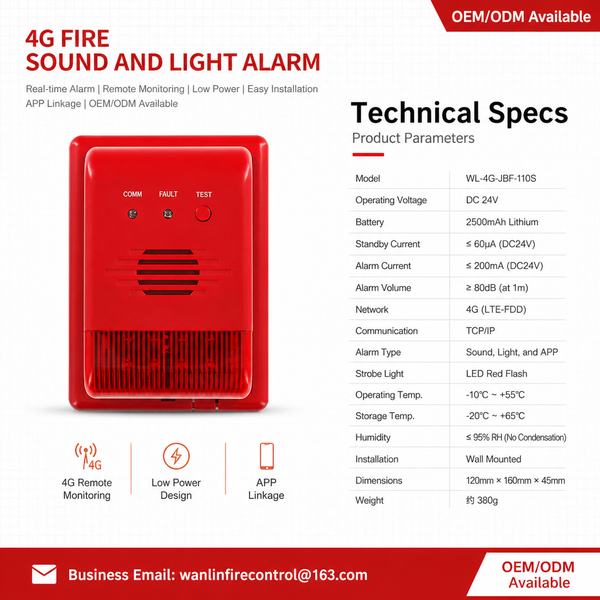
NB-IoT Alarm CIF — Certified Sounder Strobe Alarm by Wanlin Fire Control
II. Product Specifications
Product Category: Siren Strobe Alarm per EN 54-3 & EN 54-23
Brand: Wanlin Fire Control
Device Type: Combined audible and visual fire alarm notification device — integrates high-output electronic sounder with synchronized strobe light in a single enclosure
Sound Pressure Level: ≥110 dB(A) at 1 meter per EN 54-3 (measured in anechoic chamber at rated voltage, all tones). Variable volume setting: high (110 dB(A)), medium (-6 dB), low (-12 dB), and configurable via APP.
Alarm Tones: 16 selectable tones including: continuous, slow whoop, alternating 2-tone, ISO 8201 T3 evacuation, BS 5839-1 fire alarm, DIN 33404 danger signal, Swedish SS 031711, Australian AS 1670, plus 8 user-programmable tones via APP
Strobe Technology: Multi-LED synchronized strobe — 16 high-brightness LEDs, flash rate 1 Hz configurable, 270-degree beam pattern, EN 54-23 Category W-3-10 wall-mounted visual alarm device
EN 54-23 Classification: Category C-3-10 (Ceiling-mount, min 3m coverage diameter, illumination 0.5 cd/m2 at 10m distance) — suitable for open-plan offices and warehouses
Voice/Message Capability: Standard tone-only alert — the siren generates one of 8 selectable alarm tones without voice messaging. Voice module available as an optional add-on for models requiring pre-recorded evacuation messages
Synchronization: When multiple sounder strobes are connected on the same fire alarm loop or wireless network, all units synchronize their flash pattern and tone cadence automatically. Synchronized strobes prevent disorientation in corridors (asynchronous bright flashing can trigger photosensitive epilepsy or vertigo in sensitive individuals). Strobe synchronization also creates a visually coherent evacuation path when sounder strobes are visible simultaneously.
Visual Indicators: Power/Status LED (green flash every 30s = normal standby, network-connected models show solid green after last successful cloud check-in) / Alarm LED (integrated into strobe — red/white flashing pattern during alarm) / Fault LED (yellow double-flash every 10s = check device — low battery, network fault, or self-test failure)
Response Time: Alarm activation within 1 seconds of trigger signal — siren reaches full volume and strobe reaches full intensity near-instantaneously for immediate occupant alerting
Connectivity: NB-IoT (Narrowband IoT) cellular — low-power wide-area network with deep building penetration
SIM / Network: Embedded eSIM (NB-IoT) or Nano SIM — operator provisioning required
Network Independence: NB-IoT cellular connectivity via telecom operator IoT network. Deep signal penetration through walls, basements, and underground levels. Extremely low power consumption enabling multi-year battery life. Embedded eSIM or Nano SIM.
Power Supply: Built-in lithium thionyl chloride battery (3.6V, 19Ah, non-replaceable, 10-year life, -30degC to +60degC operating range) — high energy density for sustained siren output during alarm events
Low Battery Warning: Audible chirp pattern (2 short beeps every 60 seconds) + yellow LED flash 30 days before battery depletion. Network-connected models send APP push notification and SMS alert to facility manager with estimated remaining battery life.
End-of-Life Warning: Distinctive chirp + yellow LED pattern when device reaches end of rated service life — typically 10 years from manufacture date per EN 54-3/EN 54-23. Sounder strobe should be replaced when end-of-life signal activates.
Self-Test: Automatic self-test every 60 seconds — verifies sounder driver circuit continuity, speaker coil impedance, strobe LED array current, battery voltage, and wireless/network connectivity. Manual TEST button on front panel activates full functional check (3-second siren burst + strobe flash + cloud notification verification).
Tamper Protection: Built-in tamper switch — sends alert notification to monitoring platform if the sounder strobe housing is opened or removed from the mounting base. Rear tamper spring detects removal from wall/ceiling.
Installation: Wall mount at 2.0m-2.5m height from finished floor level (per BS 5839-1 for optimal sound dispersion and strobe visibility) using included mounting bracket. Two M4 screw holes with wall plugs provided. Spirit level included for alignment. Installation complete in under 10 minutes.
Strobe Coverage: Per EN 54-23 Category W-2.5-7.5: one sounder strobe covers a wall area of 2.5m width at up to 7.5m distance. For a typical 6m x 8m room, one centrally-mounted unit provides adequate visual coverage.
Sound Coverage: Covers up to 100 sqm open area per unit at the high volume setting (typical office/classroom size). Larger areas require multiple units spaced per EN 54-3 coverage pattern recommendations. Sound attenuation through doors, partitions, and acoustic ceiling tiles should be accounted for in system design.
Product Dimensions: 165 x 115 x 78 mm / approximately 420g (with battery)
Enclosure Material: UL94 V-0 flame-retardant ABS — lightweight yet durable. High-visibility red (RAL 3020 traffic red) with contrasting white label and clear strobe dome.
Operating Temperature: -10degC to +60degC
Operating Humidity: 10%-93% RH (non-condensing)
Storage Temperature: -20degC to +60degC
IP Rating: IP41 — suitable for indoor and protected outdoor use
Certification: EN 54-3:2001 / EN 54-23:2010 / CE / RoHS / FCC / REACH
Warranty: 3 years manufacturer warranty against defects
Package Contents: Sounder strobe unit, wall/ceiling mounting base bracket with security screws, wall plugs and screws (M4 x 40mm), reset/test key, installation template, user manual (multi-language), quick-start guide, EN 54-3 / EN 54-23 Declaration of Performance, warranty card
III. Why Choose Wanlin Fire Control as Your Sounder Strobe Manufacturing Partner
Selecting the right manufacturing partner for fire notification devices is a decision with life-safety implications — acoustic and optical performance, certification compliance, and consistent alarm output are non-negotiable. Wanlin Fire Control has earned trust as a preferred partner for international buyers through:
✓ Genuine Manufacturing, Not Trading: We own and operate our ISO9001:2015 certified production facility with in-house injection molding, SMT assembly lines, anechoic sound testing chambers, photometric goniometer for EN 54-23 compliance verification, environmental testing chambers, and automated functional testing stations. You communicate directly with the factory — your technical questions about EN 54-3 sound pressure requirements, EN 54-23 coverage patterns, or strobe synchronization are answered by the acoustic and optical engineers who design and build the products.
✓ Full EN 54-3 and EN 54-23 Coverage: Our manufacturing platform produces sounder strobes across the full range of EN 54-23 coverage categories (W-2.5-7.5, W-3-10, C-3-10) and EN 54-3 sound pressure levels (95-120 dB) — all independently tested and certified by notified bodies. We also offer ATEX/IECEx certified variants for hazardous areas, IP65+ weatherproof models for outdoor installations, and extended temperature range models for cold storage and industrial applications.
✓ Multi-Technology Connectivity Portfolio: We manufacture conventional sounder strobes, addressable notification devices, wireless RF interconnected models, WiFi smart sounder strobes, 4G cellular sounder strobes, NB-IoT notification devices, and LoRaWAN sounder strobes — all from one supplier. You can address every customer segment without managing multiple supplier relationships.
✓ Partner-First Business Philosophy: We are a manufacturer for distributors, not a fire system brand competing with them. Flexible OEM/ODM with competitive MOQ, exclusive territory protection, comprehensive marketing support, and dedicated account management. Our success is measured by our partners' market success.
✓ Global Deployment Experience: Our sounder strobes protect lives in German commercial towers, French hospitals, Saudi petrochemical complexes, Indonesian government housing, UAE luxury hotels, UK e-commerce brands, Brazilian industrial bakeries, Singapore data centers, Canadian schools, South African cold storage, Thai shopping malls, and Indian metro stations.
IV. What Sets the NB-IoT Alarm CIF Apart in the Global Market
The NB-IoT Alarm CIF offers distinct competitive advantages for international buyers:
1. Proven Acoustic and Optical Performance: Every sounder strobe undergoes individual functional testing — siren burst verification (sound pressure level measurement in anechoic chamber), strobe flash verification (flash rate, LED array current measurement, luminous intensity spot-check), and battery voltage verification. Speaker drivers are acoustically swept before assembly. When a Wanlin sounder strobe activates in an emergency, building occupants WILL hear and see it — guaranteed by design, verified by testing.
2. Certified Safety, Factory-Direct Value: EN 54-3 / EN 54-23 / CE (CPR 305/2011) certification combined with factory-direct pricing creates a value proposition competitors cannot match. Trading companies offer lower cost but uncertain certification and quality. Fire system brands offer certification but with brand premiums and rigid distribution models. Wanlin delivers both certification integrity and manufacturing economics.
3. The Right Sounder Strobe for Every Environment: Notification devices are NOT one-size-fits-all — the correct sound pressure level, strobe coverage category, connectivity method, and environmental rating depend on the installation. Wanlin produces the full spectrum: 95-120 dB sound output, W-2.5-7.5 through W-3-10 coverage, indoor through IP67 weatherproof, standard through ATEX/IECEx, and conventional wired through 4G cellular. One supplier covers all your customers' needs.
4. Dual-Sense Alert Effectiveness: Combined audible + visual notification in a single device ensures complete occupant coverage. The siren reaches people who cannot see the strobe (facing away, in adjacent rooms). The strobe reaches people who cannot hear the siren (hearing-impaired, wearing hearing protection, sleeping, using headphones). This redundancy is not a luxury — it is a life-safety requirement mandated by modern fire codes and accessibility regulations worldwide.
5. Regulatory-Ready for Global Markets: Every Wanlin sounder strobe is designed for certification. The core platform is lab-tested to EN 54-3/EN 54-23, and we manage country-specific certification (UL 464/UL 1638, VdS, LPCB, AS 7240.3/AS 7240.23, ABNT NBR 17240, KC) on your behalf. Multi-language voice messages available for 24+ languages.
6. 10-Year Replacement Cycle: EN 54-3/EN 54-23 and NFPA 72 recommend sounder strobe replacement after 10 years of service. Every device sold today generates a guaranteed replacement sale — creating predictable, recurring demand that builds long-term distributor business value.
Why Distributors Choose Wanlin: Eaton, System Sensor, Apollo, and Hochiki are fire system brands that sell through established distribution — they compete with new distributors for territory and margin. Wanlin is a manufacturer: we make EN 54-3/EN 54-23 certified sounder strobes to international standards, you build the brand and distribution channel in your market. We offer private labeling, OEM branding, country-specific certification management, and partnership models that fire system brands cannot provide. This fundamental difference — manufacturer-partner vs. competing brand — is why international distributors source notification devices from Wanlin.
V. Frequently Asked Questions (FAQ)
Whether you are evaluating sounder strobe suppliers, expanding your fire notification product catalog as a distributor, or specifying fire alarm notification equipment for a building project — these answers address the most common questions from international buyers considering Wanlin Fire Control as their NB-IoT Alarm CIF manufacturing partner.
Question 1: How does a sounder strobe alarm work, and what is the difference between EN 54-3 and EN 54-23?
A sounder strobe alarm — also known as an audio-visual alarm device (VAD), sounder beacon, or siren strobe — is a fire alarm notification appliance that produces BOTH an audible alarm (siren/sounder) AND a visual alarm (flashing strobe light) to alert building occupants of a fire emergency. This dual-sense alerting is critical because: audible alert reaches people who are not looking at the device (typical scenario — someone working at a desk, facing away from the sounder), visual alert reaches people who cannot hear the audible alarm (hearing-impaired individuals, people wearing hearing protection in noisy environments, people wearing headphones, sleeping people who may not respond to sound alone). EN 54-3 (Fire alarm sounders) specifies: minimum sound pressure levels (must achieve minimum 65 dB(A) or 5 dB above ambient noise, whichever is greater, in all occupied areas; minimum 75 dB(A) at the bedhead in sleeping areas), alarm tone frequency content (must include frequencies between 500 Hz and 2000 Hz for audibility across the population including those with age-related hearing loss), and endurance requirements (continuous operation at maximum volume). EN 54-23 (Visual alarm devices) specifies: luminous intensity distribution (measured by photometric goniometer — essential because the strobe must be visible from specific angles), coverage categories (W = wall-mounted, C = ceiling-mounted, O = open class), minimum illumination levels (0.5 cd/m2 at the declared coverage distance to ensure the strobe is detectable above ambient light), flash rate requirements (0.5-2 Hz), and flash color (red or white for fire, amber for non-fire). The combination of both standards in a single device ensures that EVERY building occupant receives an unambiguous fire emergency alert regardless of sensory ability or situational context. Wanlin's sounder strobes are independently tested and certified to BOTH EN 54-3 and EN 54-23.
Question 2: Where should sounder strobes be installed according to fire codes, and what coverage/spacing rules apply?
Sounder strobe placement is specified by fire codes worldwide — the principle is: EVERY occupied area in a building with a fire detection and alarm system must receive both an audible AND visual fire alarm notification. EN 54-3 / BS 5839-1 (audible coverage): minimum sound pressure level — 65 dB(A) or 5 dB above ambient background noise, whichever is greater. At the bedhead in sleeping accommodation (hotels, care homes, hospitals): minimum 75 dB(A). Sound pressure drops approximately 6 dB per doubling of distance — a 100 dB(A) sounder at 1m produces approximately 88 dB(A) at 4m, 82 dB(A) at 8m, and 76 dB(A) at 16m. Sound can be attenuated by closed doors (typically 15-25 dB per closed fire door) and acoustic ceiling tiles. Multiple sounders are required for: large open-plan areas (>100m2 typically needs 2+ sounders), areas with multiple rooms/partitions, areas with high ambient noise (industrial, kitchen, entertainment venue — may require up to 15 dB above ambient), and multi-story buildings (at least 1 sounder per floor). EN 54-23 / BS 5839-1 (visual coverage): wall-mounted VADs (Category W) — mounted at minimum 2.1m above floor, each VAD covers a specified coverage area: Category W-2.5-7.5 covers 5m x 7.5m room, W-3-10 covers 6m x 10m room. Ceiling-mounted VADs (Category C) — Category C-3-10 covers 6m diameter at 10m mounting height. As a rule of thumb: one sounder strobe per 50-100m2 of open floor area, PLUS additional units in separate rooms, corridors (one every 15m), and ancillary spaces. NFPA 72 (USA): similar principles but uses candela (cd) ratings — 15 cd for rooms up to 6m x 6m, 30 cd for 6-9m rooms, 75 cd for 9-12m rooms, 110 cd for 12-15m rooms. Wanlin provides placement planning support — send us your floor plans.
Question 3: What is the difference between EN 54-3/EN 54-23 and UL 464/UL 1638 certification for sounder strobes?
EN 54-3/EN 54-23 (Europe/International) and UL 464/UL 1638 (North America) both certify fire alarm notification appliances — but differences in testing protocols mean they are not directly interchangeable. Similarities: both test sound output (dB levels, frequency response), light output (strobe intensity, flash rate), and environmental endurance. Key differences: Sound measurement — EN 54-3 uses A-weighted dB(A) in anechoic chamber. UL 464 uses dBA in a reverberant room (different acoustic environment). Light measurement — EN 54-23 uses effective intensity (Blondel-Rey method, cd-effective). UL 1638 uses candela (cd) peak intensity measurement. Coverage — EN 54-23 defines coverage pattern categories (W-2.5-7.5, etc.). UL 1638 defines coverage by candela rating (15/30/75/110 cd). Flash rate — EN 54-23 requires 0.5-2 Hz. UL 1638 requires 1-2 Hz with specific temporal pattern (T3 = 0.5s on, 0.5s off, 0.5s on, 0.5s off, 0.5s on, 1.5s off). Acceptance: EN 54-3/EN 54-23 accepted throughout EU/EEA, UK, Middle East, Southeast Asia, parts of Africa, Australia/NZ. UL 464/UL 1638 accepted in USA and Canada. Practical guidance: for EU/UK/Middle East projects — specify EN 54-3/EN 54-23. For USA/Canada projects — specify UL 464/UL 1638. For multi-market distributors — we offer both certified versions.
Question 4: How do wireless and 4G sounder strobes compare to traditional wired sounder strobes in terms of reliability and installation cost?
The shift from wired to wireless/4G sounder strobes represents a significant total-cost-of-ownership advantage: Wired conventional sounder strobes require: fire-rated cable run from each sounder to the fire alarm panel (typically 2-core + earth), conduit or cable tray installation, electrician labor for termination and commissioning, fire stopping at every wall/floor penetration, and sounder circuit supervision (continuously monitored for open circuit, short circuit, and earth fault). Installation cost per sounder strobe: typically $60-150 for commercial installations including cabling, terminations, and commissioning. Wireless/4G sounder strobes eliminate: all field wiring between sounder and control panel, conduit and cable tray runs, fire stopping at penetrations, and most electrician labor. Installation time: under 10 minutes per unit (mount bracket on wall at correct height, attach sounder strobe, configure via APP). Total installed cost: 50-70% lower than wired equivalent. Reliability comparison: Wired — single point of failure (cut cable = entire zone may be lost). Wireless — each sounder strobe operates independently. 4G cellular — operates independently of the building's fire alarm panel, IT network, and power infrastructure. Even in a catastrophic building failure (fire damage to the fire alarm panel or cable network), 4G sounder strobes continue operating on their internal batteries. Industry adoption: EN 54-25 (components using radio links) permits wireless sounder strobes in fire detection and alarm systems. NFPA 72 permits wireless notification appliances. This technology shift is transforming fire alarm installation economics while improving system resilience.
Question 5: Can sounder strobes integrate with existing fire alarm systems, building management systems, and smart building platforms?
Wanlin sounder strobes support multiple integration pathways: Fire alarm control panel (FACP) — conventional: NC/NO monitored input for activation from fire alarm panel sounder circuit; Addressable: RS-485 / Modbus RTU output with published register map; Direct wireless to FACP: sounder strobes receive wireless activation signal from the fire alarm panel's wireless gateway. Building management system (BMS) — Modbus RTU (RS-485), BACnet gateway option, MQTT / REST API for cloud-to-cloud integration. Smart building — building automation integration via Modbus for centralized alarm management, HVAC shutdown coordination on fire alarm activation, and access control integration (release magnetic door locks on alarm). Standalone operation — all Wanlin sounder strobes function as complete standalone notification devices even without external system integration. The built-in siren and strobe provide full fire alarm notification capability with zero external dependencies. This flexibility means the same sounder strobe platform can serve: standalone residential and small commercial, large-scale addressable fire alarm systems, industrial BMS integration, IoT monitoring platforms, and smart building ecosystems.
Question 6: What maintenance do sounder strobes require over their service life, and how do self-test features reduce maintenance burden?
Sounder strobes require regular testing to ensure audible and visual alarm notification will operate reliably in an emergency: Weekly visual inspection — check that the sounder strobe is not obstructed, painted over, or damaged. Verify the status LED is flashing normally. Ensure the strobe lens is clean and clear — dust and dirt accumulation significantly reduces light output; Monthly functional test — activate the fire alarm system and verify the sounder strobe produces audible siren at the expected volume AND visible strobe flash. Walk the coverage area to verify audibility and visibility at all occupied locations. Record test results in the fire alarm logbook; Quarterly deep inspection — clean the strobe lens with a soft dry cloth. Inspect the speaker grille for blockage. Test the tamper switch. Verify mounting security — check that screws are tight. For battery-operated models, check battery voltage; Annual professional test — complete functional test per EN 54-3/EN 54-23: verify sound pressure level meets design specification (use a calibrated sound level meter), verify strobe coverage pattern (use a calibrated light meter at coverage boundary), and verify synchronization between multiple units; 10-year replacement — per EN 54-3 and NFPA 72, sounder strobes should be replaced after 10 years of service. Wanlin sounder strobes with self-test dramatically reduce this maintenance burden — automatic weekly acoustic and photometric self-test verifies siren output, strobe function, and connectivity, providing maintenance alerts only when actual service is required.
Question 7: What is the difference between a sounder, a sounder strobe, a VAD, and a sounder beacon?
These terms overlap but have specific technical meanings: Sounder (EN 54-3) = audible-only fire alarm notification device — produces alarm tones/siren. No visual component. Used where visual alert is not required by code or where separate visual alarm devices are installed. Sounder Strobe / Sounder Beacon (EN 54-3 + EN 54-23) = combined audible AND visual device in a single enclosure — the most common notification appliance type. Provides both alarm siren and flashing strobe light. Preferred because it simplifies installation, wiring, and maintenance (one device, one mounting point, one maintenance check). VAD (Visual Alarm Device, EN 54-23) = visual-only fire alarm notification device — produces strobe/flashing light only. No audible component. Used in conjunction with separate sounders or in areas where audible alarm is provided by other devices. Sounder Beacon = a subset of sounder strobe, usually referring to a cylindrical or dome-shaped enclosure with integrated siren and beacon light — common in industrial and commercial installations. Which should you stock? Sounder Strobe is the highest-volume product because it satisfies both audible and visual notification requirements in one device and is the default specification in most commercial fire alarm designs. Pure sounders and pure VADs are more specialized. As a distributor, building your product line around sounder strobes with optional sounder-only and VAD-only variants provides the best market coverage.
Question 8: Can a single sounder strobe model be used across different countries, or do I need different variants?
Sounder strobe certification is market-specific to a degree — but EN 54-3/EN 54-23 provides a harmonized European baseline. European Union — CE marked per CPR 305/2011, EN 54-3/EN 54-23 certified, DoP provided. Our standard EU model covers all 27 member states. United Kingdom — UKCA marked, BS EN 54-3 / BS EN 54-23 certified (post-Brexit). North America — UL 464 / UL 1638 listed for USA and Canada. Different testing protocols but similar performance criteria. Australia/New Zealand — AS 7240.3 / AS 7240.23 certified, RCM marked. Middle East — Civil Defence approval often requires EN 54-3/EN 54-23 certification recognized by local authority. Key market-specific requirement: alarm tone — different countries have standardized alarm tones (ISO 8201 T3 temporal pattern is the international evacuation standard, but some countries specify additional or alternative tones). Wanlin manages both the certification process and multi-tone/voice programming on your behalf — whether under Wanlin brand or OEM brand.
VI. Global Client Success Stories
Wanlin Fire Control's NB-IoT Alarm CIF has proven its life-safety notification value across diverse deployment scenarios worldwide:
✓ Hotel Chain Voice Evacuation Deployment — UAE: A UAE hospitality group operating 40 luxury hotels and resorts deployed Wanlin's voice evacuation sounder strobes across all properties. The deployment was driven by: updated UAE Fire & Life Safety Code requiring voice evacuation in hotels with more than 50 rooms, post-incident review of a kitchen fire where international guests did not understand the meaning of the alarm siren, and insurance requirement for documented voice evacuation capability. Wanlin provided: 4,200+ addressable sounder strobes with built-in voice evacuation module, EN 54-3/EN 54-23 certified with Arabic/English pre-recorded messages, distribution per property: 1-2 per guest floor corridor, 1 per lobby/atrium, 2 per restaurant/ballroom, 1 per kitchen, 1 per pool/deck area; Arabic emergency message: 'يرجى الانتباه. تم الإبلاغ عن حريق. يرجى إخلاء المبنى فورا باستخدام أقرب مخرج. لا تستخدم المصاعد' ('Attention. A fire has been reported. Please evacuate the building immediately using the nearest exit. Do not use the elevators.'); integration with hotel BMS for automated HVAC shutdown and elevator recall on fire alarm; central monitoring at each property's security office with cloud connection to group safety director in Dubai. Zero fire-related guest injuries post-deployment, guest satisfaction scores for 'safety and security' increased 18%, and 14% fire insurance premium reduction across the group.
✓ E-commerce Brand Private Label Launch — United Kingdom: A UK fire safety e-commerce brand launched a private-label sounder strobe product line manufactured entirely by Wanlin. The brand owner identified market opportunity: UK electrical contractors and building developers sourcing EN 54-3/EN 54-23 notification devices from traditional brands at high cost with limited margin. Wanlin provided full OEM: custom-branded sounder strobes with UK-specific alarm tones (BS 5839-1 fire alarm tone), EN 54-3/EN 54-23 certification managed through a UKAS-accredited laboratory, UKCA marking, custom retail packaging, installation videos filmed in UK commercial buildings, and product line launched with 6 SKUs: basic indoor (GBP 24.99), IP65 weatherproof (GBP 34.99), addressable (GBP 44.99), voice evacuation (GBP 54.99), wireless RF (GBP 59.99), and ceiling-mount VAD (GBP 39.99). Within 18 months: #1 Best Seller in Fire Alarm Sounders on Amazon UK, 4.6-star average from 210+ reviews, GBP 1.2M annual revenue from the notification device category, the product line expanded to include manual call points and detectors. The brand owner credited Wanlin's management of UKCA/BS EN 54-3/BS EN 54-23 certification as the critical success factor.
✓ School District Accessibility Compliance — Canada: A Canadian school board managing 180+ schools deployed Wanlin's comprehensive sounder strobe notification system as part of an accessibility compliance program. Previous schools had audible-only fire alarms — leaving hearing-impaired students and staff without effective fire notification, a violation of provincial accessibility legislation and human rights requirements. Wanlin provided: 7,500+ sounder strobes (wall-mount and ceiling-mount), UL 464/UL 1638 certified for Canadian market (ULC-S525/ULC-S526), English/French bilingual voice evacuation in all schools ('Fire emergency. Please evacuate using the nearest exit. / Urgence incendie. Veuillez evacuer en utilisant la sortie la plus proche.'), classrooms: wall-mounted VADs at 2.1m height per UL 1638 (15 cd for standard classroom, 30 cd for larger rooms), corridors: 110 cd strobes at 15m spacing, gymnasiums and auditoriums: 110 cd strobes with synchronized flash, visual-only VADs in music rooms and quiet study areas (flash-only alert without disrupting concentration). The deployment achieved: 100% visual notification coverage in all occupied areas — full accessibility compliance, zero accessibility-related fire safety complaints in provincial audits, and the school board has adopted Wanlin notification devices as the mandatory standard for all new school construction and major renovations.
VII. Partnership Models with Wanlin Fire Control
Wanlin Fire Control structures partnerships around your business model. As a direct manufacturer with full in-house production and R&D, we offer flexible partnership models:
Brand Distributor: Purchase Wanlin-branded NB-IoT Alarm CIF at distributor pricing → build the Wanlin brand in your territory → we provide marketing materials, technical training, and protected territory rights.
OEM / Private Label Partner: We manufacture the NB-IoT Alarm CIF to your specifications — your brand, your packaging, your language voice messages and markings — you own the customer relationship and channel. MOQ from 1000 units.
Project / Tender Partner: Joint bidding on government, commercial, or industrial fire safety projects. We provide technical proposals, EN 54-3/EN 54-23 certification documentation, reference projects, and competitive bulk pricing for large-scale deployments.
Technology / Assembly Partner: For markets requiring local content — we supply speaker driver modules, LED arrays, and PCBs for local assembly, meeting import substitution requirements while maintaining quality and acoustic performance.
E-commerce / FBA Partner: We manufacture, you sell online — full Amazon FBA prep, dropshipping, and direct-to-consumer fulfillment supported. White-label options available.
Current partnership opportunities: Exclusive country/regional distributorships available with protected territories, white-label and OEM manufacturing programs with competitive MOQ (from 1000 units), joint venture or local assembly partnerships for large markets, technology licensing for local manufacturing, and government tender partnership with full EN 54-3/EN 54-23 certification documentation.
VIII. Conclusion
Sounder strobe alarms are a mandatory and non-negotiable component of fire detection and alarm systems worldwide — required by building fire codes in every commercial, industrial, public, and multi-occupancy residential building. They provide the critical notification function without which fire detection is useless: the ability to instantly alert ALL building occupants — regardless of sensory ability, location, or activity — that they must evacuate immediately. The global sounder strobe market is experiencing steady, regulation-driven growth fueled by construction activity, fire code modernization (particularly voice evacuation and VAD accessibility mandates), smart building adoption, and the ongoing 10-year replacement cycle of aging notification device fleets.
The NB-IoT Alarm CIF from Wanlin Fire Control represents a strategic product opportunity for businesses participating in the global fire safety market. As a direct manufacturer, Wanlin offers capabilities that neither trading companies nor fire system brands can match: factory-direct pricing with full EN 54-3/EN 54-23 certification, the complete technology spectrum (from conventional wired through 4G cellular to ATEX-certified) from one supplier, built-in voice evacuation capability, flexible OEM/ODM with white-label options, and a partnership model built on shared market success rather than channel competition.
Whether you are launching a sounder strobe product line, expanding an existing fire safety catalog, sourcing fire notification equipment for a code-compliance program, or exploring private-label manufacturing — Wanlin Fire Control has the certified products, production capacity, and partnership commitment to support your business objectives.
Contact our export team today to request evaluation samples and discuss volume pricing for your market.
Email: wanlinfirecontrol@163.com | Export Service Hotline: +8613261677119 | Website: www.wanlinfire.com
Wanlin Fire Control — Your Direct Source Factory for Certified Sounder Strobe Alarms. ISO9001:2015 Certified | EN 54-3:2001 / EN 54-23:2010 / CE (CPR 305/2011) / FCC / RoHS Approved | Global Shipping & Export Documentation Support. Partner with the manufacturer — not a middleman. We welcome inquiries from distributors, importers, OEM partners, MEP contractors, government procurement, and project buyers worldwide.
